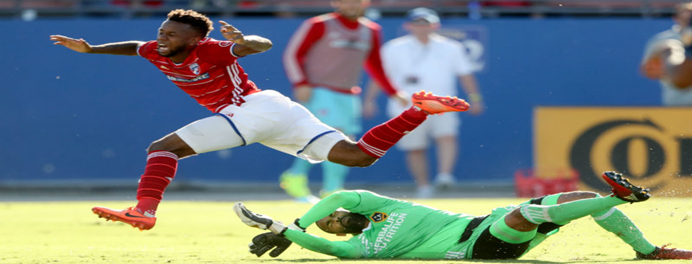
We are discussing the subject of serious foul play. The Laws of the Game describe serious foul play as follows:
Serious Foul Play
“A tackle or challenge that endangers the safety of an opponent or uses excessive force or brutality must be sanctioned as serious foul play.
“Any player who lunges at an opponent for the ball from the front, from the side or from behind using one or two legs, with excessive force or endangers the safety of an opponent is guilty of serious foul play.”
Our main responsibilities are to protect the safety of players by protecting them from unfair play.
Referees have to be able to judge the difference between those challenges that are fair from those that are not and to consider when an unfair challenge is committed with excessive force. Brutal actions involving excessive force (violence, endangering the safety of an opponent) must always result in a RED CARD!
It is always important to go through these considerations when deciding if a challenge is deemed Serious Foul Play.
Fouls: careless, reckless, using excessive force/Violent conduct
- Does the player show a lack of attention or consideration when making his challenge?
- Does the player act without precaution when making the challenge?
- Does the player act with complete disregard of the danger to his opponent?
- Does the player have a chance of playing the ball in a fair manner?
- Does the player far exceed the necessary use of force when making the challenge? What degree of speed and/or intensity is the player using when making the challenge?
- Does the player show clear malice when making the challenge?
- Does the player lunge at an opponent?
- Is the challenge clearly endangering the safety of the opponent?
In this clip we’ll examines two challenges from the game between FC Dallas and LA Galaxy where, in a five-minute spell, the referee has to decide whether they reach the level of Serious Foul Play.
In the first incident, The Blue Player commits a foul tackle from behind on Red Player. Referee, from a close position, can see that it is a scissor-type challenge that ticks some of the above boxes such as the lack of attention or consideration, and acting without precaution when making his challenge. Neither does he have a chance of playing the ball in a fair manner.
However, it is not a lunge and it lacks speed, intensity, malice and force even distance was close. Therefore, The blue player is not endangering the safety of his opponent and Referee correctly judges that it is a reckless challenge. He brandishes the yellow card in a calm manner without histrionics and the blue player fully accepts the decision, despite the fact that he actually played the ball.
Referee proceeds to ensure the defensive wall is the required 10 yards from the ball and takes a position where he can see any possible handball offense by players in the wall and keeps his AR and the majority of the players in full view. This is all good prescribed free-kick procedure.
Five minutes later, the defender attempts to play the ball back to his goalkeeper(GK). Unfortunately the pass lacks pace and Attacker(Red) starts running towards the ball. At this point, GK, who is also moving towards the ball goes airborne and makes contact with The Attacker.
Referee has no hesitation in brandishing the red card to GK who appears at first resigned to his fate and is walking off. When turning to see the red card he shows some surprise, but this is short lived and he walks off the field peacefully without further protest.
When players are airborne they have no control over their body, and therefore by lunging at an opponent endanger their safety. GK demonstrates the following:
- a lack of attention or consideration
- acts without precaution,
- shows a complete disregard of the danger to his opponent
- has little or no chance of paying the ball in a fair manner
- speed, intensity and force
Therefore, his tackle a challenge clearly endangers the safety of the opponent.
Remember law: “Any player who lunges at an opponent in challenging for the ball from the front, from the side or from behind using one or both legs, with excessive force and endangering the safety of an opponent, is guilty of serious foul play”.
DOGSO could have also been considered here but Serious Foul Play was the correct outcome because it’s more serious offence compare to DOGSO(Technical).
In summary, it is important that referees penalize all instances of serious foul play with a red card.
Four practical elements of decision making:
- See
- Recognize
- Think
- Act
Positioning is crucial when judging potential Serious Foul Play and in both of these situations Referee was in a good position to see, recognize, think and act appropriately, decisively and calmly in correctly differentiating between a reckless foul and one that endangered the safety of an opponent
Source Credit to Professional Referee Organization Week 33

 RxKLFA